

🦸🏿♂️ Gato GraphQL ahora se transpila de PHP 8.0 a 7.1

Hace algún tiempo, escribí sobre el arte de transpilar código PHP:
- Transpiling PHP code from 8.0 to 7.x via Rector
- Coding in PHP 7.4 and deploying to 7.1 via Rector and GitHub Actions
Transpilar código PHP permite usar las últimas características de PHP para desarrollo, pero lanzar el plugin con su código convertido a una versión más antigua de PHP para producción, para apuntar a una base de usuarios más grande.
He pasado las últimas semanas afinando aún más este proceso para el plugin Gato GraphQL.
Estoy contento de anunciar que, a partir de ahora, su versión requerida de PHP ha sido actualizada, a PHP 8.0:
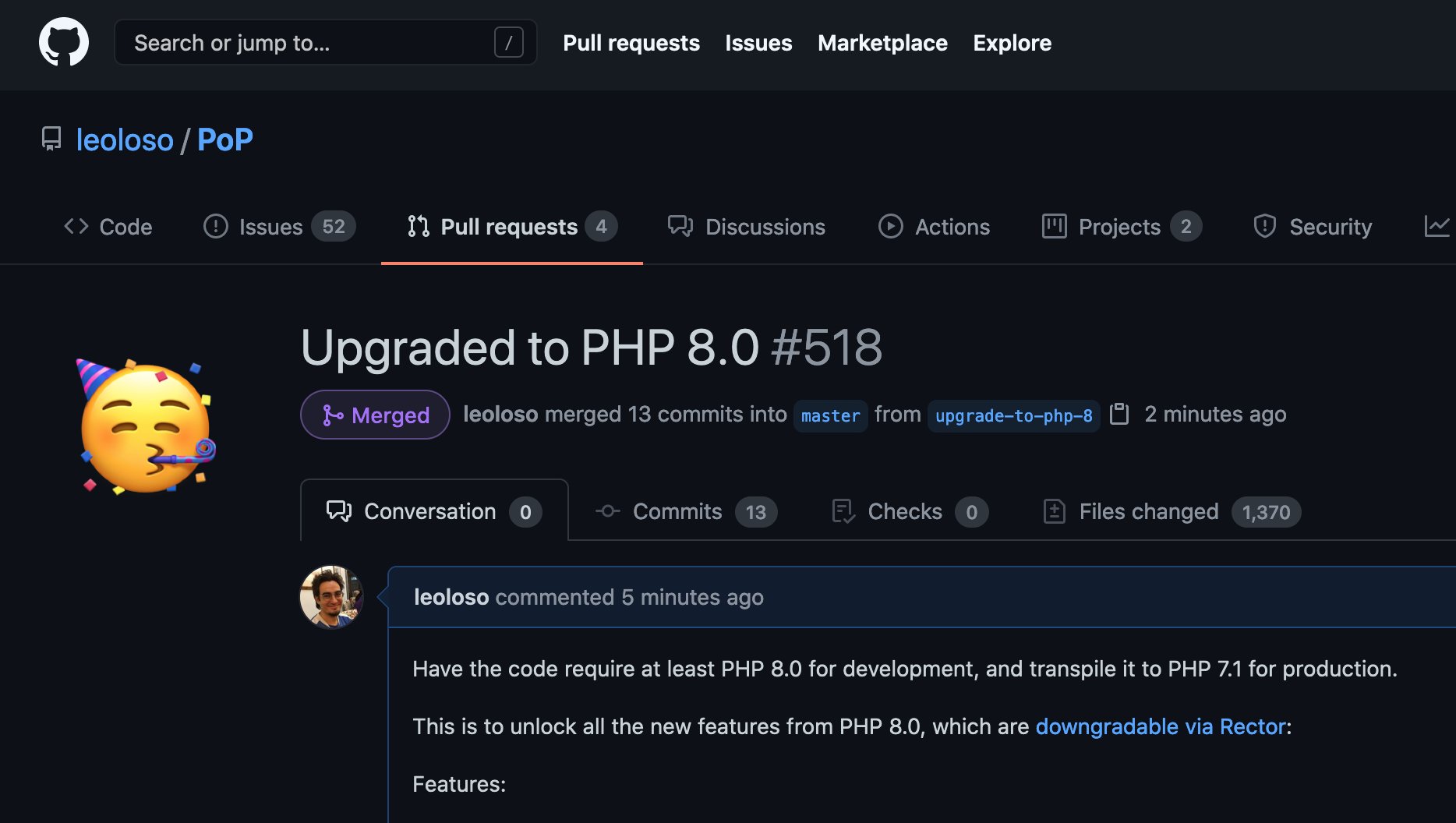
Como el plugin ahora puede contar con PHP 8.0, he podido completar la adición de un tipo a todas las propiedades para todas las clases PHP a lo largo del código base, incluyendo ahora también los union types.
¡Genial!
Aquí está el resumen de todas las nuevas características de PHP 8.0 disponibles al desarrollar el plugin.
Nuevas características de PHP 8.0
Al desarrollar Gato GraphQL, las siguientes características de PHP 8.0 están ahora disponibles:
- Union types
- Pseudo tipo
mixed - Tipo de retorno
static - Constante mágica
::classen objetos - Expresiones
match catchexcepciones solo por tipo- Operador Null-safe
- Promoción de propiedades en el constructor de clase
- Comas finales en listas de parámetros y listas
usede closures
Veamos un ejemplo de cada una, cómo se usan en el plugin para desarrollo, y a qué se transpilan al generar graphql-api.zip.
Union types
interface CustomPostTypeAPIInterface
{
public function createCustomPost(array $data): string | int | null | Error;
}Transpilado a:
interface CustomPostTypeAPIInterface
{
public function createCustomPost(array $data)
}Pseudo tipo mixed
interface CMSServiceInterface
{
public function getOption(string $option, mixed $default = false): mixed;
}Transpilado a:
interface CMSServiceInterface
{
public function getOption(string $option, $default = false);
}Constante mágica ::class en objetos
foreach ($directiveResolvers as $directiveResolver) {
$directiveResolverName = $directiveResolver->getDirectiveName();
$this->directiveNameClasses[$directiveResolverName][] = $directiveResolver::class;
}Transpilado a:
foreach ($directiveResolvers as $directiveResolver) {
$directiveResolverName = $directiveResolver->getDirectiveName();
$this->directiveNameClasses[$directiveResolverName][] = get_class($directiveResolver);
}Expresiones match
public function getSchemaFieldType(TypeResolverInterface $typeResolver, string $fieldName): ?string
{
$ret = match($fieldName) {
'accessControlLists' => TypeCastingHelpers::makeArray(SchemaDefinition::TYPE_ID),
'cacheControlLists' => TypeCastingHelpers::makeArray(SchemaDefinition::TYPE_ID),
'fieldDeprecationLists' => TypeCastingHelpers::makeArray(SchemaDefinition::TYPE_ID),
'schemaConfigurations' => TypeCastingHelpers::makeArray(SchemaDefinition::TYPE_ID),
default => parent::getSchemaFieldType($typeResolver, $fieldName),
};
return $ret;
}Transpilado a:
public function getSchemaFieldType(TypeResolverInterface $typeResolver, string $fieldName): ?string
{
switch ($fieldName) {
case 'accessControlLists':
$ret = TypeCastingHelpers::makeArray(SchemaDefinition::TYPE_ID);
break;
case 'cacheControlLists':
$ret = TypeCastingHelpers::makeArray(SchemaDefinition::TYPE_ID);
break;
case 'fieldDeprecationLists':
$ret = TypeCastingHelpers::makeArray(SchemaDefinition::TYPE_ID);
break;
case 'schemaConfigurations':
$ret = TypeCastingHelpers::makeArray(SchemaDefinition::TYPE_ID);
break;
default:
$ret = parent::getSchemaFieldType($typeResolver, $fieldName);
break;
}
return $ret;
}catch excepciones solo por tipo
try {
// ...
} catch (InvalidArgumentException) {
return sprintf(
'<p>%s</p>',
\__('Oops, the documentation for this module is not available', 'graphql-api')
);
}Transpilado a:
try {
// ...
} catch (InvalidArgumentException $exception) {
return sprintf(
'<p>%s</p>',
\__('Oops, the documentation for this module is not available', 'graphql-api')
);
}Operador Null-safe
public function getSchemaDirectiveDeprecationDescription(TypeResolverInterface $typeResolver): ?string
{
return $this->getSchemaDefinitionResolver($typeResolver)?->getSchemaDirectiveDeprecationDescription($typeResolver);
}Transpilado a:
public function getSchemaDirectiveDeprecationDescription(TypeResolverInterface $typeResolver): ?string
{
return $this->getSchemaDefinitionResolver($typeResolver) ? $this->getSchemaDefinitionResolver($typeResolver)->getSchemaDirectiveDeprecationDescription($typeResolver) : null;
}Promoción de propiedades en el constructor de clase
abstract class AbstractEndpointResolver
{
function __construct(protected EndpointHelpers $endpointHelpers)
{
}
}Transpilado a:
abstract class AbstractEndpointResolver
{
/**
* @var \GraphQLAPI\GraphQLAPI\Services\Helpers\EndpointHelpers
*/
protected $endpointHelpers;
function __construct(EndpointHelpers $endpointHelpers)
{
$this->endpointHelpers = $endpointHelpers;
}
}Comas finales en listas de parámetros y listas use de closures
public function resolveFieldTypeResolverClass(TypeResolverInterface $typeResolver, string $fieldName): ?string
{
switch ($fieldName) {
case 'accessControlLists':
return CustomPostTypeResolver::class;
}
return parent::resolveFieldTypeResolverClass(
$typeResolver,
$fieldName,
);
}Transpilado a:
public function resolveFieldTypeResolverClass(TypeResolverInterface $typeResolver, string $fieldName): ?string
{
switch ($fieldName) {
case 'accessControlLists':
return CustomPostTypeResolver::class;
}
return parent::resolveFieldTypeResolverClass($typeResolver, $fieldName);
}