

Bloques (Gutenberg)
Así es como se obtienen los datos de los bloques de Gutenberg.
El esquema GraphQL tiene los siguientes campos añadidos a todos los tipos CustomPost (como Post y Page):
blocksblockDataItemsblockFlattenedDataItems
Estos campos no se habilitan si el plugin Classic Editor está activo.
blocks
El campo CustomPost.blocks: [BlockUnion!] obtiene la lista de todos los bloques contenidos en el custom post.
blocks devuelve una lista de los tipos Block que han sido mapeados al esquema GraphQL. Estos tipos Block forman parte del tipo BlockUnion e implementan la interfaz Block.
El plugin implementa un tipo Block, GenericBlock, que ya es suficiente para obtener los datos de cualquier bloque (a través del campo attributes: JSONObject).
Esta consulta:
{
post(by: { id: 1 }) {
blocks {
...on Block {
name
attributes
innerBlocks {
...on Block {
name
attributes
innerBlocks {
...on Block {
name
attributes
}
}
}
}
}
}
}
}
}...producirá esta respuesta:
{
"data": {
"post": {
"blocks": [
{
"name": "core/gallery",
"attributes": {
"linkTo": "none",
"className": "alignnone",
"images": [
{
"url": "https://d.pr/i/zd7Ehu+",
"alt": "",
"id": "1706"
},
{
"url": "https://d.pr/i/jXLtzZ+",
"alt": "",
"id": "1705"
}
],
"ids": [],
"shortCodeTransforms": [],
"imageCrop": true,
"fixedHeight": true,
"sizeSlug": "large",
"allowResize": false
},
"innerBlocks": null
},
{
"name": "core/heading",
"attributes": {
"content": "List Block",
"level": 2
},
"innerBlocks": null
},
{
"name": "core/list",
"attributes": {
"ordered": false,
"values": "<li>List item 1</li><li>List item 2</li><li>List item 3</li><li>List item 4</li>"
},
"innerBlocks": null
},
{
"name": "core/heading",
"attributes": {
"className": "has-top-margin",
"content": "Columns Block",
"level": 2
},
"innerBlocks": null
},
{
"name": "core/columns",
"attributes": {
"isStackedOnMobile": true
},
"innerBlocks": [
{
"name": "core/column",
"attributes": {},
"innerBlocks": [
{
"name": "core/image",
"attributes": {
"id": 1701,
"className": "layout-column-1",
"url": "https://d.pr/i/fW6V3V+",
"alt": ""
},
"innerBlocks": null
}
]
},
{
"name": "core/column",
"attributes": {},
"innerBlocks": [
{
"name": "core/paragraph",
"attributes": {
"className": "layout-column-2",
"content": "Phosfluorescently morph intuitive relationships rather than customer directed human capital.",
"dropCap": false
},
"innerBlocks": null
}
]
}
]
},
{
"name": "core/heading",
"attributes": {
"content": "Columns inside Columns (nested inner blocks)",
"level": 2
},
"innerBlocks": null
},
{
"name": "core/columns",
"attributes": {
"isStackedOnMobile": true
},
"innerBlocks": [
{
"name": "core/column",
"attributes": {},
"innerBlocks": [
{
"name": "core/image",
"attributes": {
"id": 1701,
"className": "layout-column-1",
"url": "https://d.pr/i/fW6V3V+",
"alt": ""
},
"innerBlocks": null
},
{
"name": "core/columns",
"attributes": {
"isStackedOnMobile": true
},
"innerBlocks": [
{
"name": "core/column",
"attributes": {
"width": "33.33%"
},
"innerBlocks": [
{
"name": "core/heading",
"attributes": {
"fontSize": "large",
"content": "Life is so rich",
"level": 2
},
"innerBlocks": null
},
{
"name": "core/heading",
"attributes": {
"level": 3,
"content": "Life is so dynamic"
},
"innerBlocks": null
}
]
},
{
"name": "core/column",
"attributes": {
"width": "66.66%"
},
"innerBlocks": [
{
"name": "core/paragraph",
"attributes": {
"content": "This rhyming poem is the spark that can reignite the fires within you. It challenges you to go out and live your life in the present moment as a “hero” and leave your mark on this world.",
"dropCap": false
},
"innerBlocks": null
},
{
"name": "core/columns",
"attributes": {
"isStackedOnMobile": true
},
"innerBlocks": [
{
"name": "core/column",
"attributes": {},
"innerBlocks": [
{
"name": "core/image",
"attributes": {
"id": 361,
"sizeSlug": "large",
"linkDestination": "none",
"url": "https://gato-graphql.lndo.site/wp-content/uploads/2022/05/graphql-voyager-public-1024x622.jpg",
"alt": ""
},
"innerBlocks": null
}
]
},
{
"name": "core/column",
"attributes": {},
"innerBlocks": null
},
{
"name": "core/column",
"attributes": {},
"innerBlocks": [
{
"name": "core/image",
"attributes": {
"id": 362,
"sizeSlug": "large",
"linkDestination": "none",
"url": "https://gato-graphql.lndo.site/wp-content/uploads/2022/05/namespaced-interactive-schema-1024x598.webp",
"alt": ""
},
"innerBlocks": null
}
]
}
]
}
]
}
]
}
]
}
]
}
]
}
}
}El esquema GraphQL para los tipos Block tiene este aspecto:
interface Block {
name: String!
attributes: JSONObject
innerBlocks: [BlockUnion!]
contentSource: HTML!
}
type GenericBlock implements Block {
name: String!
attributes: JSONObject
innerBlocks: [BlockUnion!]
contentSource: HTML!
}
union BlockUnion = GenericBlockCampos de Block
La interfaz Block (y, por lo tanto, el tipo GeneralBlock) contiene los siguientes campos:
nameobtiene el nombre del bloque:"core/paragraph","core/heading","core/image", etc.attributesobtiene un objeto JSON que contiene todos los atributos del bloque.innerBlocksobtiene[BlockUnion!], por lo que podemos consultarlo para navegar por la jerarquía de bloques que contienen bloques anidados y obtener los datos de todos ellos, en cuantos niveles tengamos en nuestro contenido.contentSourceobtiene el código fuente HTML (Gutenberg) del bloque, incluyendo los delimitadores de comentario que contienen los atributos. Sin embargo, este campo no obtiene exactamente los mismos datos que como se almacenan en la BD (consulta #2346), así que utilízalo con cuidado.
Obtener GeneralBlock directamente (en lugar de BlockUnion)
Como actualmente solo hay un tipo Block mapeando bloques —GeneralBlock— tiene sentido que CustomPost.blocks (y también Block.innerBlocks) obtengan este tipo directamente, en lugar del tipo BlockUnion.
Podemos hacerlo en la página de Settings, en la pestaña Blocks, marcando la opción Use single type instead of union type?:
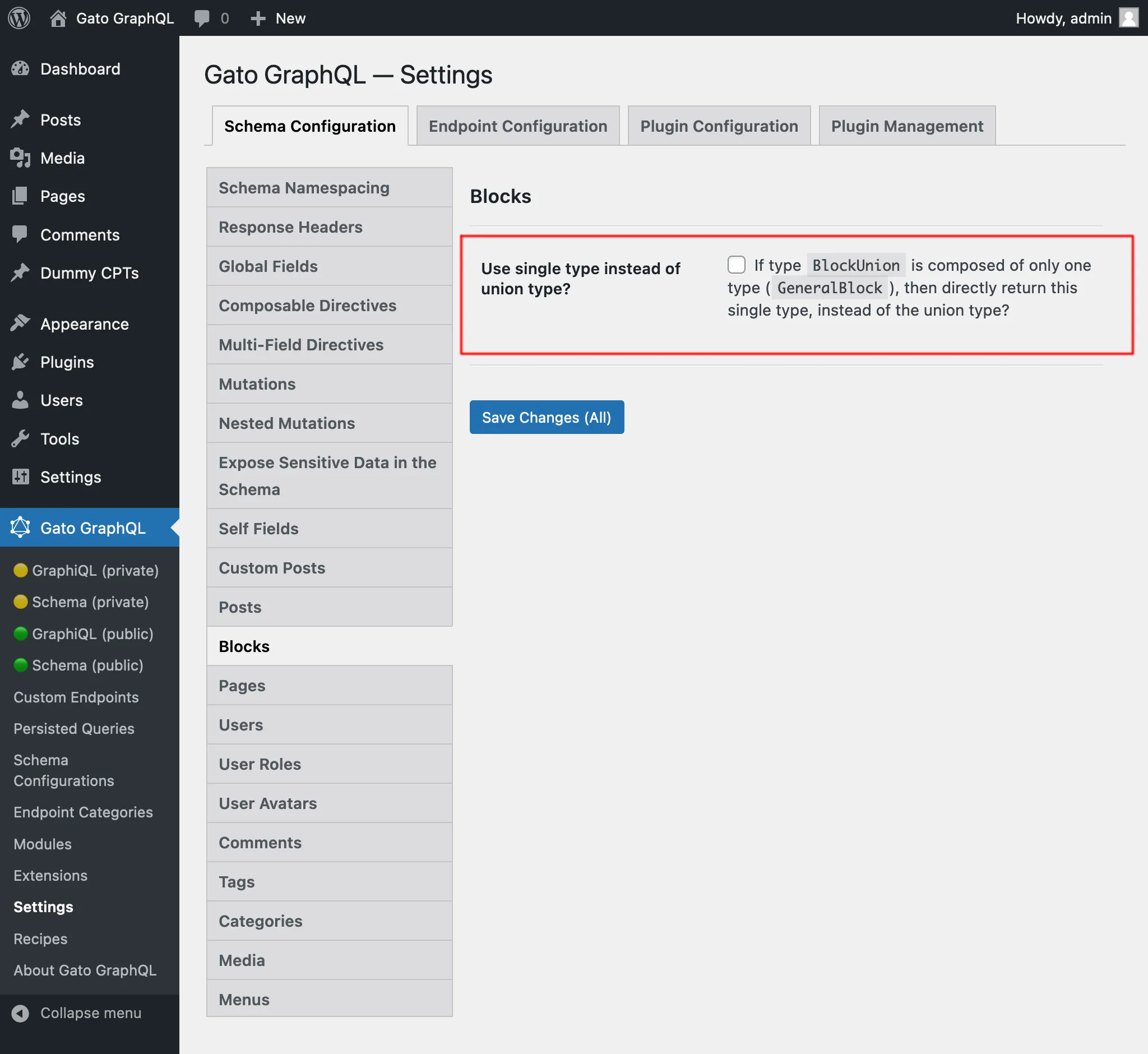
Entonces, la consulta GraphQL se simplifica:
{
post(by: { id: 1 }) {
blocks {
name
attributes
innerBlocks {
name
attributes
}
}
}
}Ten en cuenta que mantener el tipo de respuesta como BlockUnion es bueno para la compatibilidad futura: si alguna vez decidimos añadir tipos específicos de bloque al esquema (consulta la sección siguiente), no habrá cambios disruptivos.
Mapear tipos específicos de bloque
El tipo JSONObject (tal como lo obtiene Block.attributes) no está fuertemente tipado: sus propiedades pueden tener cualquier tipo y cardinalidad (String, Int, [Boolean!], etc.), por lo que necesitamos conocer esta información para cada bloque y tratar con cada caso en el cliente.
Si necesitamos un tipado estricto, debemos extender el esquema GraphQL mediante código PHP, añadiendo tipos específicos de bloque que mapeen los atributos específicos de un bloque como campos y los hagan parte de BlockUnion.
Por ejemplo, podemos añadir el tipo CoreParagraphBlock que mapee el bloque core/paragraph, con un campo content de tipo String.
Consulta la documentación en GatoGraphQL/GatoGraphQL para aprender cómo extender el esquema GraphQL (actualmente en desarrollo).
Filtrar bloques
El campo CustomPost.blocks contiene el argumento filterBy con dos propiedades: include y exclude. Podemos usarlas para filtrar qué bloques se obtienen, por el nombre del bloque:
{
post(by: { id: 1 }) {
id
blocks(
filterBy: {
include: [
"core/heading",
"core/gallery"
]
}
) {
name
attributes
}
}
}Esto producirá:
{
"data": {
"post": {
"blocks": [
{
"name": "core/gallery",
"attributes": {
"linkTo": "none",
"className": "alignnone",
"images": [
{
"url": "https://d.pr/i/zd7Ehu+",
"alt": "",
"id": "1706"
},
{
"url": "https://d.pr/i/jXLtzZ+",
"alt": "",
"id": "1705"
}
],
"ids": [],
"shortCodeTransforms": [],
"imageCrop": true,
"fixedHeight": true,
"sizeSlug": "large",
"allowResize": false
},
"innerBlocks": null
},
{
"name": "core/heading",
"attributes": {
"content": "List Block",
"level": 2
},
"innerBlocks": null
},
{
"name": "core/heading",
"attributes": {
"className": "has-top-margin",
"content": "Columns Block",
"level": 2
},
"innerBlocks": null
},
{
"name": "core/heading",
"attributes": {
"content": "Columns inside Columns (nested inner blocks)",
"level": 2
},
"innerBlocks": null
}
]
}
}
}Ten en cuenta que no se han incluido todos los bloques de tipo core/heading: los que están anidados bajo core/column se han excluido, ya que no hay forma de alcanzarlos (puesto que los bloques core/columns y core/column están a su vez excluidos).
Inconvenientes del campo blocks
El campo blocks produce el inconveniente de que, para obtener todos los datos de bloque contenidos en el custom post, incluyendo los datos de los bloques anidados, y sus propios bloques anidados, y así sucesivamente, debemos saber cuántos niveles de bloques anidados hay en el contenido, y reflejar esta información en la consulta GraphQL.
O, si no lo sabemos, debemos componer la consulta con suficientes niveles como para asegurarnos de que todos los datos se obtendrán.
Por ejemplo, esta consulta obtiene hasta 7 niveles de anidamiento de bloques:
{
post(by: { id: 1 }) {
blocks {
...BlockData
}
}
}
fragment BlockData on Block {
name
attributes
innerBlocks {
...on Block {
name
attributes
innerBlocks {
...on Block {
name
attributes
innerBlocks {
...on Block {
name
attributes
innerBlocks {
...on Block {
name
attributes
innerBlocks {
...on Block {
name
attributes
innerBlocks {
...on Block {
name
attributes
innerBlocks {
...on Block {
name
attributes
}
}
}
}
}
}
}
}
}
}
}
}
}
}
}blockDataItems
Para evitar el inconveniente de cómo el campo blocks obtiene todos los datos (incluyendo los de sus bloques anidados, y los anidados de estos, y así sucesivamente), existe el campo CustomPost.blockDataItems.
Este campo, en lugar de devolver [BlockUnion], devuelve [JSONObject!]:
type CustomPost {
blockDataItems: [JSONObject!]
}En otras palabras, en lugar de seguir la forma típica de GraphQL en la que las entidades se relacionan con entidades y navegamos a través de ellas, cada entidad Block en el nivel superior ya produce todos los datos de bloque para sí misma y todos sus descendientes, dentro de un único resultado JSONObject.
El objeto JSON contiene las propiedades del bloque (bajo las entradas name y attributes) y las de sus bloques anidados (bajo la entrada innerBlocks), de forma recursiva.
Por ejemplo, la siguiente consulta:
{
post(by: { id: 1 }) {
blockDataItems
}
}...producirá:
{
"data": {
"post": {
"blockDataItems": [
{
"name": "core/gallery",
"attributes": {
"linkTo": "none",
"className": "alignnone",
"images": [
{
"url": "https://d.pr/i/zd7Ehu+",
"alt": "",
"id": "1706"
},
{
"url": "https://d.pr/i/jXLtzZ+",
"alt": "",
"id": "1705"
}
],
"ids": [],
"shortCodeTransforms": [],
"imageCrop": true,
"fixedHeight": true,
"sizeSlug": "large",
"allowResize": false
}
},
{
"name": "core/heading",
"attributes": {
"content": "List Block",
"level": 2
}
},
{
"name": "core/list",
"attributes": {
"ordered": false,
"values": "<li>List item 1</li><li>List item 2</li><li>List item 3</li><li>List item 4</li>"
}
},
{
"name": "core/heading",
"attributes": {
"className": "has-top-margin",
"content": "Columns Block",
"level": 2
}
},
{
"name": "core/columns",
"attributes": {
"isStackedOnMobile": true
},
"innerBlocks": [
{
"name": "core/column",
"attributes": {},
"innerBlocks": [
{
"name": "core/image",
"attributes": {
"id": 1701,
"className": "layout-column-1",
"url": "https://d.pr/i/fW6V3V+",
"alt": ""
}
}
]
},
{
"name": "core/column",
"attributes": {},
"innerBlocks": [
{
"name": "core/paragraph",
"attributes": {
"className": "layout-column-2",
"content": "Phosfluorescently morph intuitive relationships rather than customer directed human capital.",
"dropCap": false
}
}
]
}
]
},
{
"name": "core/heading",
"attributes": {
"content": "Columns inside Columns (nested inner blocks)",
"level": 2
}
},
{
"name": "core/columns",
"attributes": {
"isStackedOnMobile": true
},
"innerBlocks": [
{
"name": "core/column",
"attributes": {},
"innerBlocks": [
{
"name": "core/image",
"attributes": {
"id": 1701,
"className": "layout-column-1",
"url": "https://d.pr/i/fW6V3V+",
"alt": ""
}
},
{
"name": "core/columns",
"attributes": {
"isStackedOnMobile": true
},
"innerBlocks": [
{
"name": "core/column",
"attributes": {
"width": "33.33%"
},
"innerBlocks": [
{
"name": "core/heading",
"attributes": {
"fontSize": "large",
"content": "Life is so rich",
"level": 2
}
},
{
"name": "core/heading",
"attributes": {
"level": 3,
"content": "Life is so dynamic"
}
}
]
},
{
"name": "core/column",
"attributes": {
"width": "66.66%"
},
"innerBlocks": [
{
"name": "core/paragraph",
"attributes": {
"content": "This rhyming poem is the spark that can reignite the fires within you. It challenges you to go out and live your life in the present moment as a “hero” and leave your mark on this world.",
"dropCap": false
}
},
{
"name": "core/columns",
"attributes": {
"isStackedOnMobile": true
},
"innerBlocks": [
{
"name": "core/column",
"attributes": {},
"innerBlocks": [
{
"name": "core/image",
"attributes": {
"id": 361,
"sizeSlug": "large",
"linkDestination": "none",
"url": "https://gato-graphql.lndo.site/wp-content/uploads/2022/05/graphql-voyager-public-1024x622.jpg",
"alt": ""
}
}
]
},
{
"name": "core/column",
"attributes": {}
},
{
"name": "core/column",
"attributes": {},
"innerBlocks": [
{
"name": "core/image",
"attributes": {
"id": 362,
"sizeSlug": "large",
"linkDestination": "none",
"url": "https://gato-graphql.lndo.site/wp-content/uploads/2022/05/namespaced-interactive-schema-1024x598.webp",
"alt": ""
}
}
]
}
]
}
]
}
]
}
]
}
]
}
]
}
}
}Filtrar elementos de datos de bloque
Al igual que blocks, blockDataItems también permite filtrar qué bloques se obtienen, mediante el argumento filterBy.
Esta consulta:
{
post(by: { id: 1 }) {
id
blockDataItems(
filterBy: {
include: [
"core/heading"
]
}
)
}
}...producirá:
{
"data": {
"post": {
"blockDataItems": [
{
"name": "core/heading",
"attributes": {
"content": "List Block",
"level": 2
},
"innerBlocks": null
},
{
"name": "core/heading",
"attributes": {
"className": "has-top-margin",
"content": "Columns Block",
"level": 2
},
"innerBlocks": null
},
{
"name": "core/heading",
"attributes": {
"content": "Columns inside Columns (nested inner blocks)",
"level": 2
},
"innerBlocks": null
}
]
}
}
}Ten en cuenta que, al igual que con blocks, no se han incluido todos los bloques de tipo core/heading: los que están anidados bajo core/column se han excluido, ya que no hay forma de alcanzarlos (puesto que los bloques core/columns y core/column están a su vez excluidos).
blockFlattenedDataItems
Ambos campos blocks y blockDataItems permiten filtrar qué bloques se obtienen (mediante el argumento filterBy). En ambos casos, si un bloque satisface la condición de inclusión, pero está anidado dentro de un bloque que no la satisface, será excluido.
Hay ocasiones, sin embargo, en las que necesitamos obtener todos los bloques de un cierto tipo del custom post, independientemente de dónde se encuentren estos bloques dentro de la jerarquía. Por ejemplo, podemos querer incluir todos los bloques de tipo core/image, para obtener todas las imágenes incluidas en una entrada del blog.
Para satisfacer esta necesidad existe el campo CustomPost.blockFlattenedDataItems. A diferencia de los campos blocks y blockDataItems, este aplana la jerarquía de bloques en un único nivel.
Esta consulta:
{
post(by: { id: 1 }) {
blockFlattenedDataItems
}
}...producirá:
{
"data": {
"post": {
"blockFlattenedDataItems": [
{
"name": "core/gallery",
"attributes": {
"linkTo": "none",
"className": "alignnone",
"images": [
{
"url": "https://d.pr/i/zd7Ehu+",
"alt": "",
"id": "1706"
},
{
"url": "https://d.pr/i/jXLtzZ+",
"alt": "",
"id": "1705"
}
],
"ids": [],
"shortCodeTransforms": [],
"imageCrop": true,
"fixedHeight": true,
"sizeSlug": "large",
"allowResize": false
},
"innerBlockPositions": null,
"parentBlockPosition": null
},
{
"name": "core/heading",
"attributes": {
"content": "List Block",
"level": 2
},
"innerBlockPositions": null,
"parentBlockPosition": null
},
{
"name": "core/list",
"attributes": {
"ordered": false,
"values": "<li>List item 1</li><li>List item 2</li><li>List item 3</li><li>List item 4</li>"
},
"innerBlockPositions": null,
"parentBlockPosition": null
},
{
"name": "core/heading",
"attributes": {
"className": "has-top-margin",
"content": "Columns Block",
"level": 2
},
"innerBlockPositions": null,
"parentBlockPosition": null
},
{
"name": "core/columns",
"attributes": {
"isStackedOnMobile": true
},
"innerBlockPositions": [
5,
7
],
"parentBlockPosition": null
},
{
"name": "core/column",
"attributes": {},
"parentBlockPosition": 4,
"innerBlockPositions": [
6
]
},
{
"name": "core/image",
"attributes": {
"id": 1701,
"className": "layout-column-1",
"url": "https://d.pr/i/fW6V3V+",
"alt": ""
},
"parentBlockPosition": 5,
"innerBlockPositions": null
},
{
"name": "core/column",
"attributes": {},
"parentBlockPosition": 4,
"innerBlockPositions": [
8
]
},
{
"name": "core/paragraph",
"attributes": {
"className": "layout-column-2",
"content": "Phosfluorescently morph intuitive relationships rather than customer directed human capital.",
"dropCap": false
},
"parentBlockPosition": 7,
"innerBlockPositions": null
},
{
"name": "core/heading",
"attributes": {
"content": "Columns inside Columns (nested inner blocks)",
"level": 2
},
"innerBlockPositions": null,
"parentBlockPosition": null
},
{
"name": "core/columns",
"attributes": {
"isStackedOnMobile": true
},
"innerBlockPositions": [
11
],
"parentBlockPosition": null
},
{
"name": "core/column",
"attributes": {},
"parentBlockPosition": 10,
"innerBlockPositions": [
12,
13
]
},
{
"name": "core/image",
"attributes": {
"id": 1701,
"className": "layout-column-1",
"url": "https://d.pr/i/fW6V3V+",
"alt": ""
},
"parentBlockPosition": 11,
"innerBlockPositions": null
},
{
"name": "core/columns",
"attributes": {
"isStackedOnMobile": true
},
"parentBlockPosition": 11,
"innerBlockPositions": [
14,
17
]
},
{
"name": "core/column",
"attributes": {
"width": "33.33%"
},
"parentBlockPosition": 13,
"innerBlockPositions": [
15,
16
]
},
{
"name": "core/heading",
"attributes": {
"fontSize": "large",
"content": "Life is so rich",
"level": 2
},
"parentBlockPosition": 14,
"innerBlockPositions": null
},
{
"name": "core/heading",
"attributes": {
"level": 3,
"content": "Life is so dynamic"
},
"parentBlockPosition": 14,
"innerBlockPositions": null
},
{
"name": "core/column",
"attributes": {
"width": "66.66%"
},
"parentBlockPosition": 13,
"innerBlockPositions": [
18,
19
]
},
{
"name": "core/paragraph",
"attributes": {
"content": "This rhyming poem is the spark that can reignite the fires within you. It challenges you to go out and live your life in the present moment as a “hero” and leave your mark on this world.",
"dropCap": false
},
"parentBlockPosition": 17,
"innerBlockPositions": null
},
{
"name": "core/columns",
"attributes": {
"isStackedOnMobile": true
},
"parentBlockPosition": 17,
"innerBlockPositions": [
20,
22,
23
]
},
{
"name": "core/column",
"attributes": {},
"parentBlockPosition": 19,
"innerBlockPositions": [
21
]
},
{
"name": "core/image",
"attributes": {
"id": 361,
"sizeSlug": "large",
"linkDestination": "none",
"url": "https://gato-graphql.lndo.site/wp-content/uploads/2022/05/graphql-voyager-public-1024x622.jpg",
"alt": ""
},
"parentBlockPosition": 20,
"innerBlockPositions": null
},
{
"name": "core/column",
"attributes": {},
"parentBlockPosition": 19,
"innerBlockPositions": null
},
{
"name": "core/column",
"attributes": {},
"parentBlockPosition": 19,
"innerBlockPositions": [
24
]
},
{
"name": "core/image",
"attributes": {
"id": 362,
"sizeSlug": "large",
"linkDestination": "none",
"url": "https://gato-graphql.lndo.site/wp-content/uploads/2022/05/namespaced-interactive-schema-1024x598.webp",
"alt": ""
},
"parentBlockPosition": 23,
"innerBlockPositions": null
}
]
}
}
}Observa cómo ha desaparecido el atributo innerBlocks, ya que los bloques ya no están anidados. En su lugar, la respuesta incluye otros dos atributos (que nos permiten recrear la jerarquía de bloques):
parentBlockPosition: la posición del bloque padre dentro del array devuelto, onullsi es un bloque de nivel superiorinnerBlockPositions: un array con las posiciones de los bloques anidados del bloque dentro del array devuelto
Filtrar los elementos de datos aplanados
Ahora que la jerarquía de bloques se ha aplanado, filtrar por core/heading producirá todos esos bloques (incluso si alguno de ellos está originalmente anidado bajo un bloque que ha sido excluido).
Esta consulta:
{
post(by: { id: 1 }) {
id
blockFlattenedDataItems(
filterBy: {
include: [
"core/heading"
]
}
)
}
}...producirá:
{
"data": {
"post": {
"blockFlattenedDataItems": [
{
"name": "core/heading",
"attributes": {
"content": "List Block",
"level": 2
}
},
{
"name": "core/heading",
"attributes": {
"className": "has-top-margin",
"content": "Columns Block",
"level": 2
}
},
{
"name": "core/heading",
"attributes": {
"content": "Columns inside Columns (nested inner blocks)",
"level": 2
}
},
{
"name": "core/heading",
"attributes": {
"fontSize": "large",
"content": "Life is so rich",
"level": 2
}
},
{
"name": "core/heading",
"attributes": {
"level": 3,
"content": "Life is so dynamic"
}
}
]
}
}
}Ten en cuenta que los dos atributos adicionales, parentBlockPosition e innerBlockPositions, se eliminan al filtrar, ya que ya no tienen sentido.